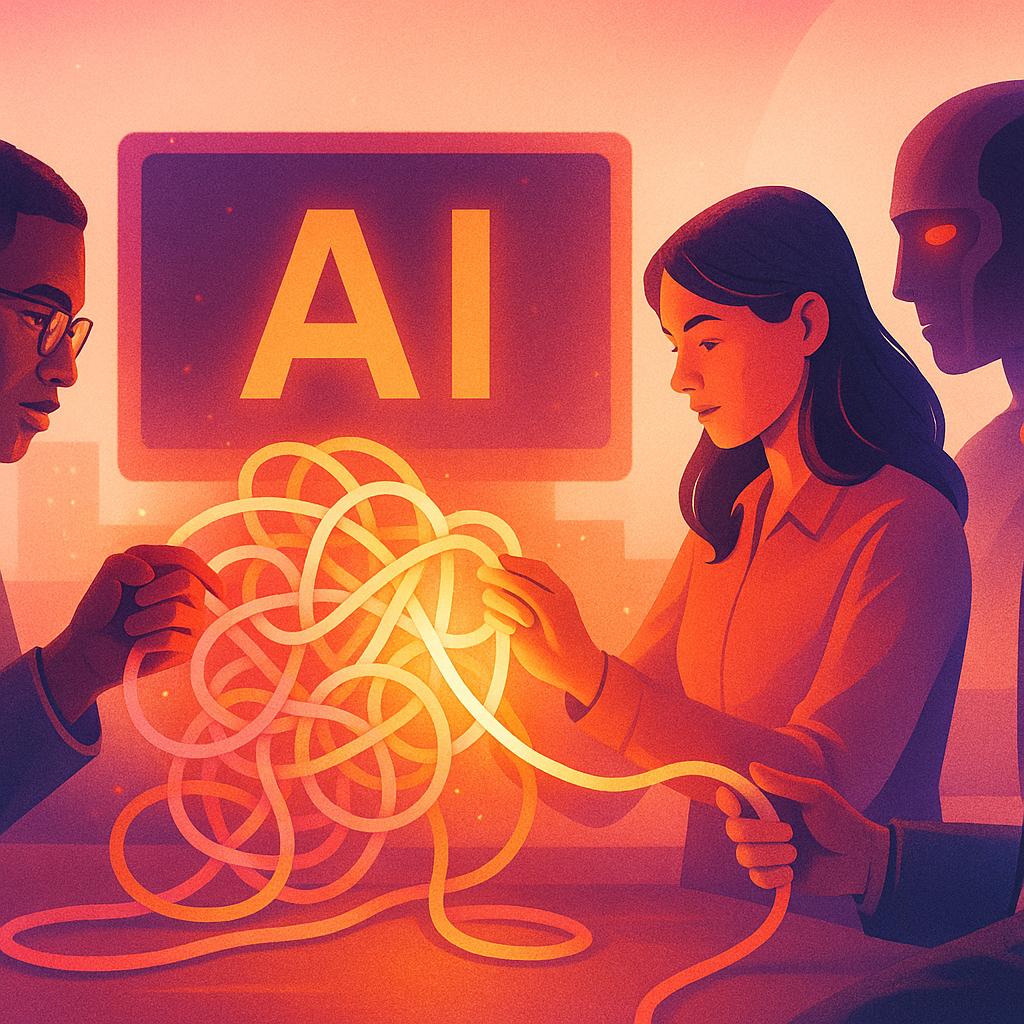



Ah, the jigsaw puzzle that is the Artificial Intelligence (AI) industry, a maze of bits and pieces of news, launching a kaleidoscope of conjectures. From Microsoft’s CEO commenting about its AI data center strategy to OpenAI’s partnership with Oracle, it’s easy to lose your way through the AI labyrinth. Let’s take a moment to step back and look at the broader view, shall we?
To kick things off, let’s take a look at the recent conversation surrounding Satya Nadella, the CEO of Microsoft, as he discussed the company’s AI data center strategy. Unveiling their view of the future tech landscape, he outlined Microsoft’s vision of serving the world with a global fleet of AI-equipped data centers, not just a single hub in Texas. A bold statement indeed, outlaying a future in which AI is not confined to a physical location, rather finding its home in a global network – the true essence of a World Wide Web!
On the other side of the stage, OpenAI, an AI research lab that once had an exclusive partnership with Microsoft, is now partnering with Oracle to build its supercomputer. A move that, on the surface, might have made some Microsoft executives more than a little hot under the collar. But, Nadella appeared unfazed, citing his belief that the world of AI is large enough for multiple players and partnerships to coexist.
A backdrop to these narratives is the story of OpenAI’s transformative approach. Its business model hovers around the concept of offering AI models to businesses. But again, the world of AI is vast and nebulous, and OpenAI’s dominance faces competition from open-source models put forth by outfits like Meta and DeepSeek. Both these models are conveniently available on Microsoft Azure, a feature touted by Nadella, arguing fiercely that open-source alternatives insure the AI industry against a potential “winner-takes-all” scenario.
This dynamic field, with its incessant twists and turns, reinforces the understanding that the future of AI is not the monopoly of a single corporation, but a playground for innovation, partnerships, and competition. It’s a world expanding on the backs of multiple players and thier collaborative efforts.
Diving deeper than the tech jargon and corporate politics is the potential impact these changes might ripple onto consumer markets. For one, we are moving towards an increasingly interconnected world, where every product and service will eventually be tied, in one way or another, to artificial intelligence. Companies are already leveraging AI for enhanced user experiences and efficiency improvements.
Take, for example, Meta’s bid to make its large language model, Llama, a tool not only for big businesses but also for the U.S. government. It demonstrates the critical role AI will play in private-public partnerships. From social media platforms to commerce to government policies, AI will soon be the unseen hand driving these sectors, impacting consumer trends in ways we might not fully comprehend yet.
Indeed, the vistas of AI are shaped by these multiple
narratives—strong data center strategies, partnerships for creating supercomputers, open-source campaigns, and government collaborations. The AI jigsaw puzzle invites every industry to immerse and embrace this transforming landscape, not as mere spectators but as active participants, learning, adapting and evolving to shape a world where AI is the artist and we are the infinitely fascinating canvas.
Remember, the future of AI is not a straightforward path but more akin to a magical mystery tour, one which needs us to stay continuously vigilant, adaptable, and creative in understanding and unfolding the prospects that lie in every corner of its labyrinth!